


How I Work: Creating The Spaces Where Profitable Conversations Happen
Every page on this site comes back to the same claim – that the bottleneck holding your firm back is usually a conversation no one can have from inside. Which raises a fair question: if the conversation is so important, why hasn’t it happened already? These are intelligent, capable people. Why can’t they just have it?
Because a real conversation – the kind that names the hard thing and resolves it – doesn’t happen just because everyone’s in the room. It needs conditions. Most meetings don’t have them, which is why most meetings circle the problem without ever landing on it.
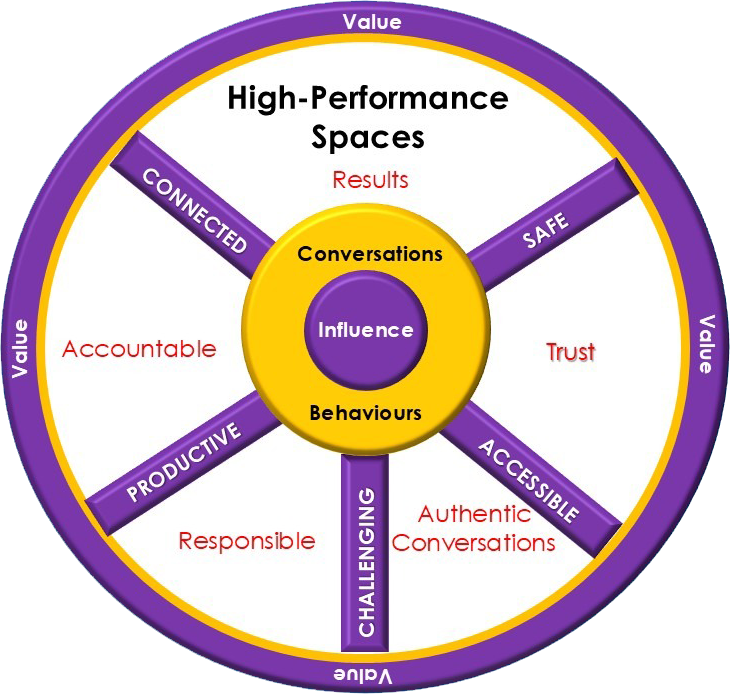
Over the years I’ve come to see that the conversations that change things share five conditions. I call the result a high-performance space, and creating it is most of what I do. Take any one condition away and the conversation quietly fails – usually so quietly no one notices why.
Safe. If people don’t feel safe to speak, they won’t say the thing that matters. They’ll manage the risk instead – stay quiet, agree in the room and disagree in the corridor, protect their position. Nothing real gets said, so nothing real gets solved.
Accessible. People can only engage with a conversation they can get hold of. Pitched too abstractly – strategy in the clouds, jargon, a problem no one can quite grip – and they nod along with nothing to work with. The same happens when there’s no clear purpose or agenda: nothing concrete on the table to engage with. The issue must be brought down to something specific and shared, or people stay on the outside of it even when they want in.
Together, safe and accessible do one job: they build trust. And trust is the hinge the whole space turns on – because only a group that trusts each other will let itself be challenged.
Challenging. This is where the value is – the elephant named, assumptions tested, the hard questions asked, the group stretched past what any one person would have reached alone. It’s also the part firms skip most, and the reason they skip it is that they reach for it too early. Try to challenge a room that doesn’t feel safe and hasn’t got hold of the issue, and it closes up – the attempt backfires, and no one wants to try again. Challenge only works once the trust beneath it is already there.
Productive. A challenging conversation that ends without decisions is just a good discussion – and firms have plenty of those. The space must convert into something: clear actions, owned by named people, with dates. This is where accountability lives. Without it, the insight evaporates by the following week, and everyone wonders why nothing changed.
Connected. No conversation stands alone. Each one connects back to the wider firm and forward to what comes next – this meeting to the last, this decision to the firm’s direction. When a space is disconnected, good conversations happen in pockets and never add up to anything. Connection is what turns a series of meetings into momentum.
The reason firms can’t clear their own bottlenecks usually isn’t that they lack the answer. It’s that they’ve never had a space with all five conditions at once – so the conversation that would surface the answer can’t get off the ground. That’s the work. I don’t bring you the answer. I create the space where your own people can finally have the conversation that gets to it.